In November, a meeting was held in Innsbruck between the partners of the Interreg Italy-Austria Breathing project, which is coordinated by Arpav.

Breathing Team November 2025
Atmospheric Physics and Chemistry Group, University of Innsbruck
In November, a meeting was held in Innsbruck between the partners of the Interreg Italy-Austria Breathing project, which is coordinated by Arpav.
Breathing Team November 2025
VOCentinel at IAO: A New Era of Continuous VOC Monitoring
In summer 2025, a prototype of IONICON’s new VOCentinel was successfully deployed at the IAO of the University of Innsbruck, where it is now carrying out its intended mission: the long-term, continuous monitoring of volatile organic compounds (VOCs) in the ambient atmosphere.
The ideal instrument of continuous, hands-off VOC monitoring
Since the establishment in 2014, the IAO has added instrumentation to continuously measure fluxes of methane, and ethane, along with almost a dozen VOC campaigns. However, continuous, high-resolution VOC measurements have historically been too labor-intensive and challenging.
For a while, the Team at IAO was looking for a VOC monitor that reports concentrations of VOCs and automatically handles detector tuning, calibrations, background subtractions, and other data preprocessing. We desired the same functionality as the other online instruments, which are typically dedicated to only one or two trace-gas species.
The key advantage of PTR-MS is that it can detect thousands of VOC species, spanning many orders of magnitude in concentration and volatility. The VOCentinel can now successfully bridge this gap.

Longterm urban eddy covariance observations of methane and other trace gases reveal characteristic anthropogenic emission hotspots
Extended Poster EGU25-5202
Synopsis: Long-term urban eddy covariance observations of methane, CO2 and other trace gases allow to constrain important emission sources. We find that most methane is released activity driven towards the top of the urban inertial sublayer (and not necessarily only at ground level) via post-meter emissions from gas furnace operations. Unburned methane then escapes through chimneys into the urban atmosphere.
Mapping CH4 in urban areas is still challenging because emissions are often diffuse. A new study https://doi.org/10.1016/j.atmosenv.2024.120743 finds evidence of urban superemitters that can substantially incrase emissions.
A recent paper by Pfannerstil highlights the potential of airborne eddy flux measurements (Temperature-dependent emissions dominate aerosol and ozone formation in Los Angeles | Science). They show that up to 60% of the VOC reactivity is associated with biogenic emissions. Despite the great strides that have been made in reducing urban pollution in major North America and European cities, there is much that remains unclear about the causes of such pollution. Mapping urban haze | Science
We are proud to be part of the new FWF funded project on the future of mountain forests under a drier climate.
The Future of Mountain Forests – Universität Innsbruck (uibk.ac.at)
Mountain regions are especially affected by climatic changes and mountain forests are expected to be exposed to increasing drought stress. This project aims at analysing if and how drier conditions influence carbon and water balances from tree to forest level, change plant stress responses and interactions with microbial communities, and affect ecosystem services.
The overarching research objective of the Biosphere-Atmosphere Interactions group is to quantify the two-way interactions and feedbacks between Alpine ecosystems and the atmosphere. The emission of reactive biogenic trace gases by terrestrial ecosystems as precursors of air pollutants and secondary organic aerosols and the associated warming (e.g. because of positive feedbacks of tropospheric ozone on net primary productivity) and cooling (due to aerosol-radiation and aerosol-cloud interactions) is amongst the most poorly constrained feedbacks in the climate system. Within this activity we will develop a framework to investigate positive and negative feedbacks on tropospheric chemistry from major Alpine ecosystems affected by ongoing climate change.
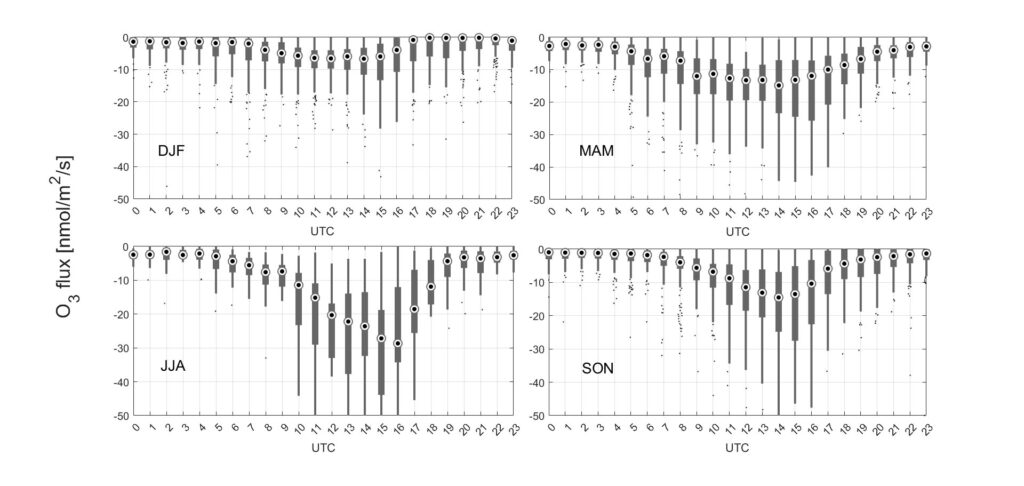
The fraction of ozone near the surface in urban areas tends to be overestimated in atmospheric models. New observations at the IAO reveal a possible explanation, which is presented in the following paper https://www.science.org/doi/10.1126/sciadv.add2365
Short summary: Long-term eddy covariance measurements of O3, NO and NO2, combined with models and remote sensing observations over an urban area, allowed disentangling important physical and chemical processes. When generalized our findings suggest that the depositional ozone flux near the surface in urban environments is negligible compared to the flux caused by chemical conversion of ozone. This leads to an underestimation of the Leighton ratio, and is a key process for modulating urban NO2 mixing ratios.
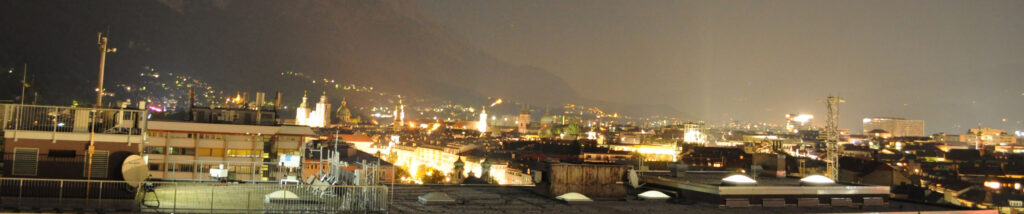
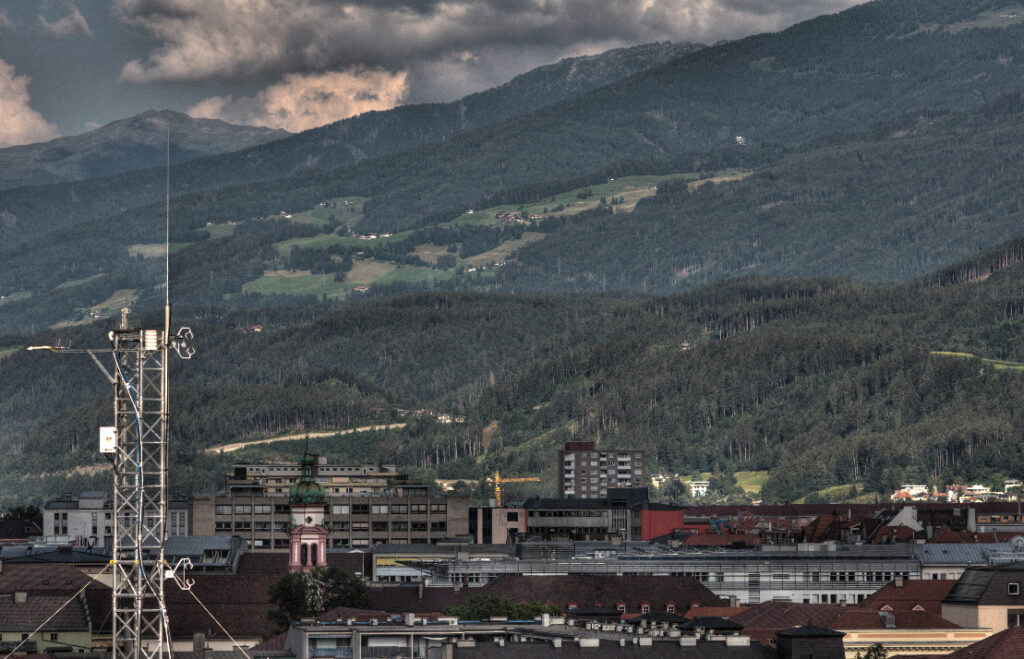
Entering our 6th year of #urban #CO2 flux observations.
We will start posting flux data on http://www.europe-fluxdata.eu/
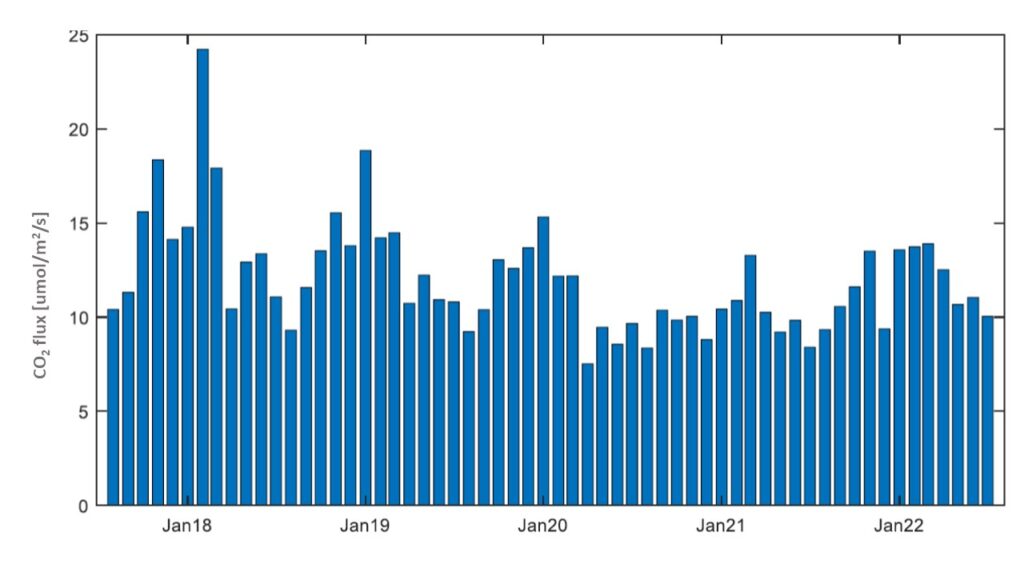
So far we have collected 5 years of CO2 (H2O), heat, momentum and NOx fluxes, 3+ years of O3 fluxes, 2+ years of CH4 fluxes and 6+ years of intermittent VOC fluxes.
some recent papers:
https://www.sciencedirect.com/science/article/pii/S0048969722017557
https://acp.copernicus.org/articles/22/6559/2022/
https://acp.copernicus.org/articles/22/5603/2022/
https://acp.copernicus.org/articles/21/3091/2021/
https://journals.ametsoc.org/view/journals/bams/101/6/BAMS-D-19-0270.A.xml
https://www.nature.com/articles/s41598-017-02699-9?sf98484848=1
https://www.pnas.org/doi/abs/10.1073/pnas.1714715115
@tomkarl@atmoschem.org
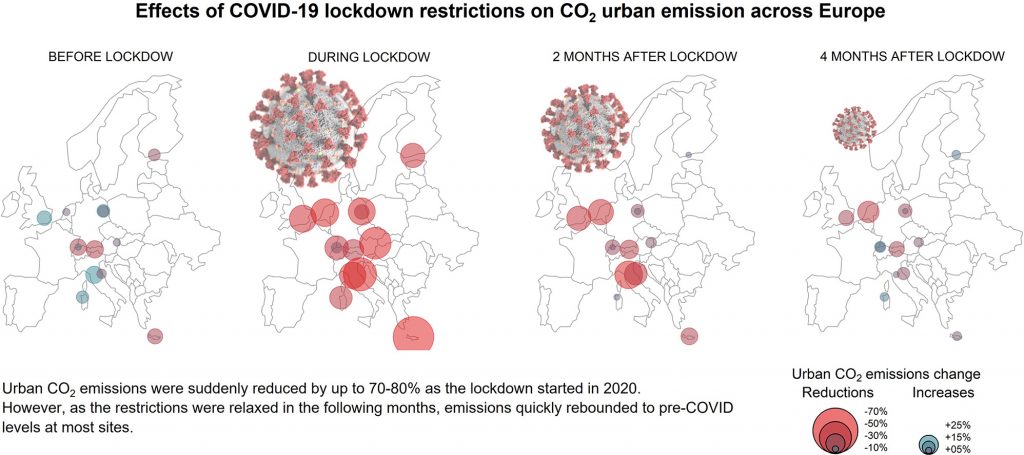
The paper by Nicolini et al., shows the variability and reduction potential of CO2 emissions across Europe.
Data show first measured evidence of a consistent reduction of CO2 emissions, proportional to the stringency of restrictions.
Analysis of air quaility data in Vienna (Brancher et al., 2021) shows a reduction of NO2 by 20% during the hard Lockdown in 2020, but no significant changes in Ox.