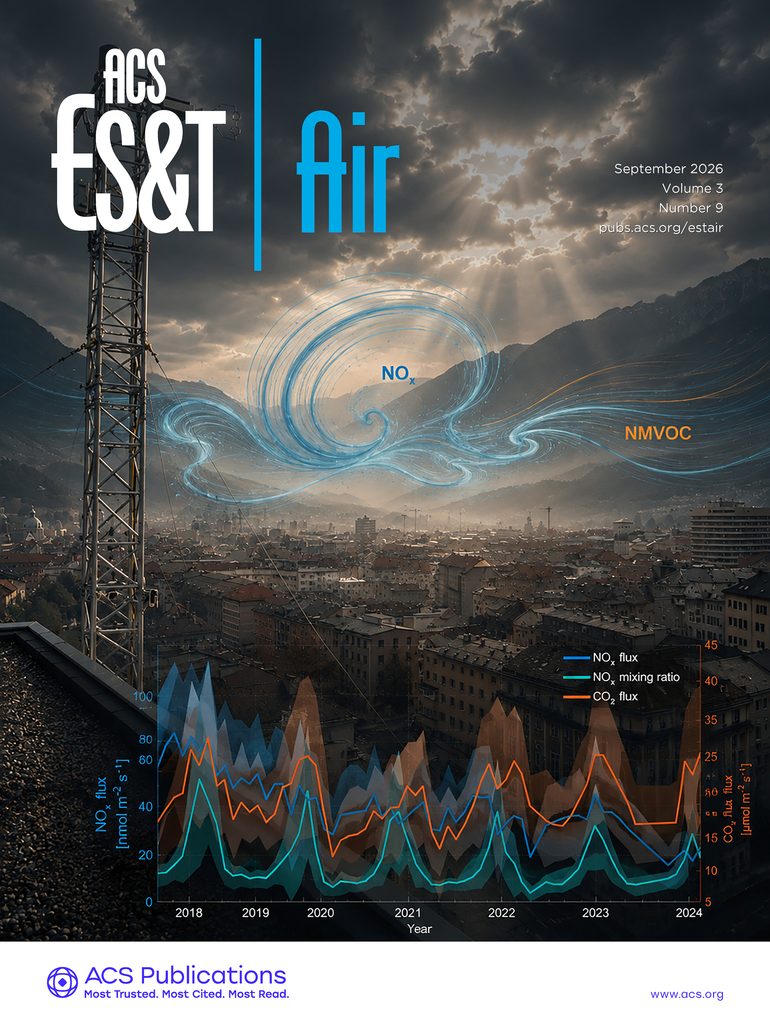
Long-term measurements at the Innsbruck Atmospheric Observatory reveal a 70% reduction in traffic-related nitrogen oxide emissions between 2018 and 2024, highlighting the effectiveness of cleaner vehicle technologies Comparable reductions in BTEX emissions were found.
A new study published in ACS ES&T Air by researchers at the University of Innsbruck provides compelling evidence that traffic-related air pollutant emissions have declined substantially over the past decade. Using nearly ten years of continuous atmospheric measurements at the Innsbruck Atmospheric Observatory (IAO), the research team investigated how emissions of nitrogen oxides (NOx) and volatile organic compounds (NMVOCs) have evolved in an Alpine urban environment.
Unlike conventional air-quality monitoring, which measures pollutant concentrations, the researchers employed the eddy-covariance technique to directly quantify emissions entering the atmosphere. By combining these measurements with carbon dioxide fluxes, satellite observations, and emission inventories, they were able to distinguish changes in vehicle emission performance from changes in traffic activity.
The results show that traffic-dominated NOx emissions decreased by approximately 70% between 2018 and 2024, with annual reductions reaching 17%. Similar declines were observed for aromatic hydrocarbons, including benzene and toluene, which are important traffic-related air pollutants. Because traffic volumes remained relatively stable, the findings indicate that improvements in vehicle exhaust treatment and changes in fleet composition have been major drivers of these reductions.
Satellite observations from the European Sentinel-5P mission independently confirm widespread reductions in NO2 pollution along major Alpine transport corridors, including the Inn Valley and Brenner motorway. However, the study also reveals important discrepancies between measured emissions and official European emission inventories. Older inventories underestimated real-world NOx emissions by up to a factor of three, while some recent revisions appear to overestimate them.
The study demonstrates that European vehicle emission policies and technological improvements are producing measurable environmental benefits. At the same time, it highlights the importance of long-term atmospheric observations for independently assessing emission inventories, evaluating air-quality policies, and improving future air-pollution predictions.
Publication: Karl, T., et al. (2026). Rapid Declines in European Traffic NOx and NMVOC Emissions Revealed by Eddy-Covariance and Remote Sensing. ACS ES&T Air.
ACS EST Air (2026) 3 (9): 2366–2377.
https://doi.org/10.1021/acsestair.6c00158